

The Rise of Pericles and the Acropolis building program
The Golden Age of Athens and the Buildings that stand for Democracy

This is a standalone article supplementary to Meridians:
EP4: “From The Oracle of Delphi to the Rise of Pharmacology.”
To listen to the episode, search for "Meridians" wherever you get your podcasts.
Spotify | Apple | Podcast Addict | Pocket Casts
The Persian Wars and Formation of The Delian League
In 492 BCE, the Persian Emperor Darius I invaded Greece to exact revenge for the Greeks' support of a revolt in Ionia and the burning of the local Persian capital, Sardis.

This was cover; Darius wanted to expand his empire’s control westward. He sent emissaries to Greek city-states, demanding their submission to Persian rule.

Athens and Sparta refused to surrender, killing the emissaries. With their allies, Athens then confronted Darius at Marathon, where they enveloped the Persians and pushed them back into the sea, forcing a retreat.

Ten years later, a new emperor would arrive. Xerxes, this time with hundreds of thousands of soldiers, sailed in on 600-1200 triremes.

Xerxes would have a famous victory at Thermopylae, defeating the Spartan General Leonidas. Persian forces then set their sights on Athens. With the city previously evacuated, the Persians burned it to the ground.

Athenian General Themistocles then hit back at sea at the Battle of Salamis. He tricked the Persian forces into a narrow strait, making the large Persian numbers count for nothing. The Persians would again be repelled.

In the aftermath of this war, the independent Greek city-states agreed to form a confederation, a defensive alliance against Persians and other threats. This alliance would be known as The Delian League.
In the Age of Pericles
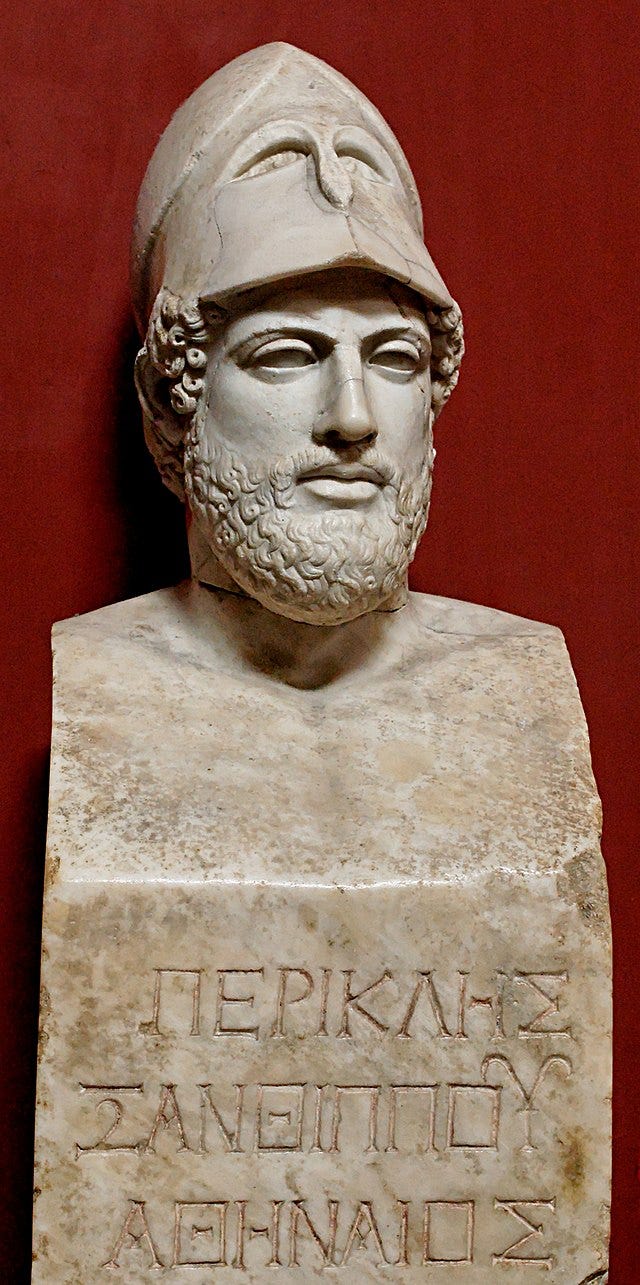
Pericles was born around 495 BCE into a powerful family. His mother was from the Alcmaeonid clan who were wealthy and very active in Athenian politics since the 7th century BCE. Pericles' father, Xanthippus, was a politician and military general who would spend much of Pericles’ childhood fighting in the Persian wars, returning home a war hero. He would die in 475 BCE when Pericles would have been about 20 years of age.
Then, it was time for Pericles’ time to rise up and make a name for himself. He’d spent his youth mostly in quiet study, preferring to avoid public appearances. This would change dramatically as his political career began.
In his early career, he presented a play, “The Persians,” in 472 BCE at Greater Dionysia, a large festival held in Athens. He financed the play and put himself out as a ‘Liturgy,’ which is a person who financed the State with their own wealth; a common practice at the time. The play depicted Themistocles’ victory at Salamis, which was a way for Pericles to say he supported Themistocles and opposed the conservative faction led by Cimon.
Pericles money may have got him in the door of the democratic faction, but his skill as an orator gave him respect and recognition. The ancient Greek historian Thucydides described Pericles' speeches as having a "thundering eloquence" with bold poetical imagery. Ephailtes, the leader of the democratic faction, would become his mentor, making his rise in the political landscape almost assured.
Cimon quickly became Pericles’ biggest political rival. He was a fierce leader who won several military victories. That, along with being the son of the former conservative leader made Cimon into a leading political figure. He would have also been highly influential in the Delian League.
In the conservative’s view, democracy was working, and no further democratic reform was needed. His faction feared populism and political turmoil if too much power was spread out across the lower classes. On the other hand, the democratic faction wanted to give the lower classes more power and extend democracy to all Greeks.
One of Pericles’ first big political moves was prosecuting Cimon, charging him with corruption for neglecting Athens’s interest in Macedon. Specifically, he claimed Cimon took bribes not to invade Macedonia. This was seen as “neglecting vital Athenian interest in Macedon.”
This prosecution failed, and Cimon was acquitted. However, it revealed a weakness in support for the conservative faction. A year later, Sparta snubbed Cimon when he arranged to send reinforcements to their aid to help quell a revolt. Sparta refused aid telling the Athenian forces to ‘go home.’ This resulted in major political embarrassment for Cimon. A year after that, the democratic faction saw ‘blood in the water’ and struck again, this time more aggressively against the conservatives.
Pericles' mentor, Ephailtes, successfully pushed through reforms that would limit the power of the Areopagus. This aristocratic council had long been influential in Greek politics and was a sanctuary of conservative beliefs.
For their second blow, Pericles again prosecuted Cimon for corruption. This time, Cimon was found guilty of ‘aiding Spartan interests.’ He was ostracized from Athens for ten years.
With Cimon out of the way, Pericles’ political party, led by his mentor Ephailtes, was in control of Athens. Unfortunately for the democratic faction, Ephailtes was assassinated that same year. There are several theories about who killed Ephailtes. One theory was that someone within his political party killed him, but having many political enemies, it could have been anybody. The case was never solved. The result was that Pericles would now be able to consolidate his power. From here, Pericles would dominate the political landscape for decades to come.
He would continue to make democratic reforms, which Ephailtes had started, further strengthening Athenian democracy. He even tried to form a pan-Hellenic congress at Athens in a way to unify Greeks further. This project would ultimately fail mainly due to Spartan opposition.
Pericles went on to win military victories, capturing Aegina and gaining control of Boeotia and Phocis. These victories helped turn Delian League allies into Athenian subjects, slowly converting power in the Delian League to Athens.
In 454 BC, Pericles moved the headquarters and treasury of the Delian League from Delos to Athens, ostensibly to protect them from Persians threatening Egypt and Asia Minor at the time. This move was seen as a symbolic gesture of Athens' power in the League and essentially marked the beginning of the Athenian Empire.
Now unfettered, Pericles put the Delian League funds into action by setting out on an ambitious building project to restore Athens; this building program is historically referred to as The Pericles Building Program or the Acropolis Building Program.
Get with the Program
The Building Program started in the early 440s BC, with major projects beginning around 447 BC. The program aimed to rebuild temples that the Persians had previously destroyed. It was also a political move to display Athens’ Imperial might and cultural achievements. It also employed Athenian craftsmen and Artisans—a sort of ‘Government jobs’ program.
The building program was overseen by Phidias, an artist at the peak of his career when the projects began. Phidias was considered one of the greatest artists of his day, so he was the obvious choice to oversee the project. He’d already completed several notable projects by this time, including the colossal bronze statue of Athena Promachos, which the then-exiled Cimon had commissioned.
Pericles and Philias also shared a vision for Athens: to transform it into a cultural and artistic center. Phidias brought the aesthetic visuals, and Pericles brought the political will and capital to make it happen.
Most of the construction projects in this program were located in the same place:
The Acropolis
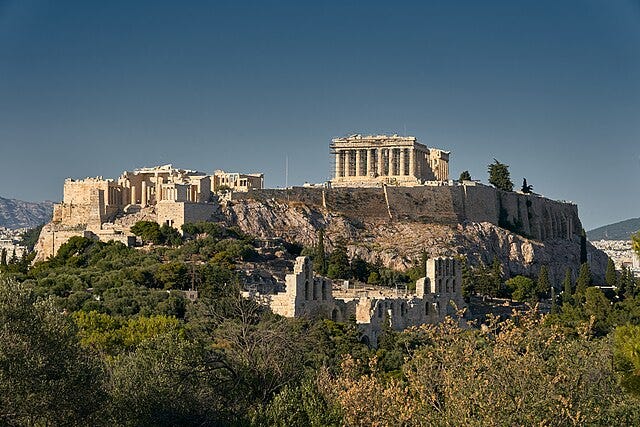
The Acropolis of Athens was very old, even by the time of Athenian occupation. The Greek Mycenaeans were the first to build fortification walls around it, building a fortified settlement in the 13th century BCE.
The first major temples were built by early Athenians in the 7th and 6th centuries BCE. These temples, including the Old Temple of Athena, were destroyed when Xerxes invaded the city in 480 BCE.
The Acropolis Building program involved the construction of four major structures on the Acropolis: the Parthenon, the Propylaea, the Temple of Athena Nike, and the Temple of Erechtheion.
Thucydides, the leader of the conservative faction in Athens, denounced the building program as an extravagance. He felt that using Delian League funds to finance construction projects specifically for Athens was immoral.
Pericles argued that the Allies were paying for their defense, and Athens didn’t need to account for how the money was spent if that defense was assured.
The program also effectively redistributed wealth, after a fashion. Given the work of the Pericles program provided, the lower classes would find themselves employed. This would likely have driven to more support for the democratic faction.
The building program made Athens one of the most glorious cities in the world at the time, creating some of the greatest architectural masterpieces in history.
In 431 BCE, Athens went to war again, this time against fellow Greeks. The Acropolis building program was never completed, and several projects were left unfinished. Two years later, Pericles died of a plague that hit Athens.
Pericles helped Athens rebuild itself and become a dominant force in the region. In his life, he had a noble vision of Athens as a cultural center of humanity and was a steadfast leader in democratic reform. For this reason, this time in Greek history is called the “Age of Pericles,” also called the “Golden Age of Athens.”
Bonus: The Iconic Temples of the Acropolis
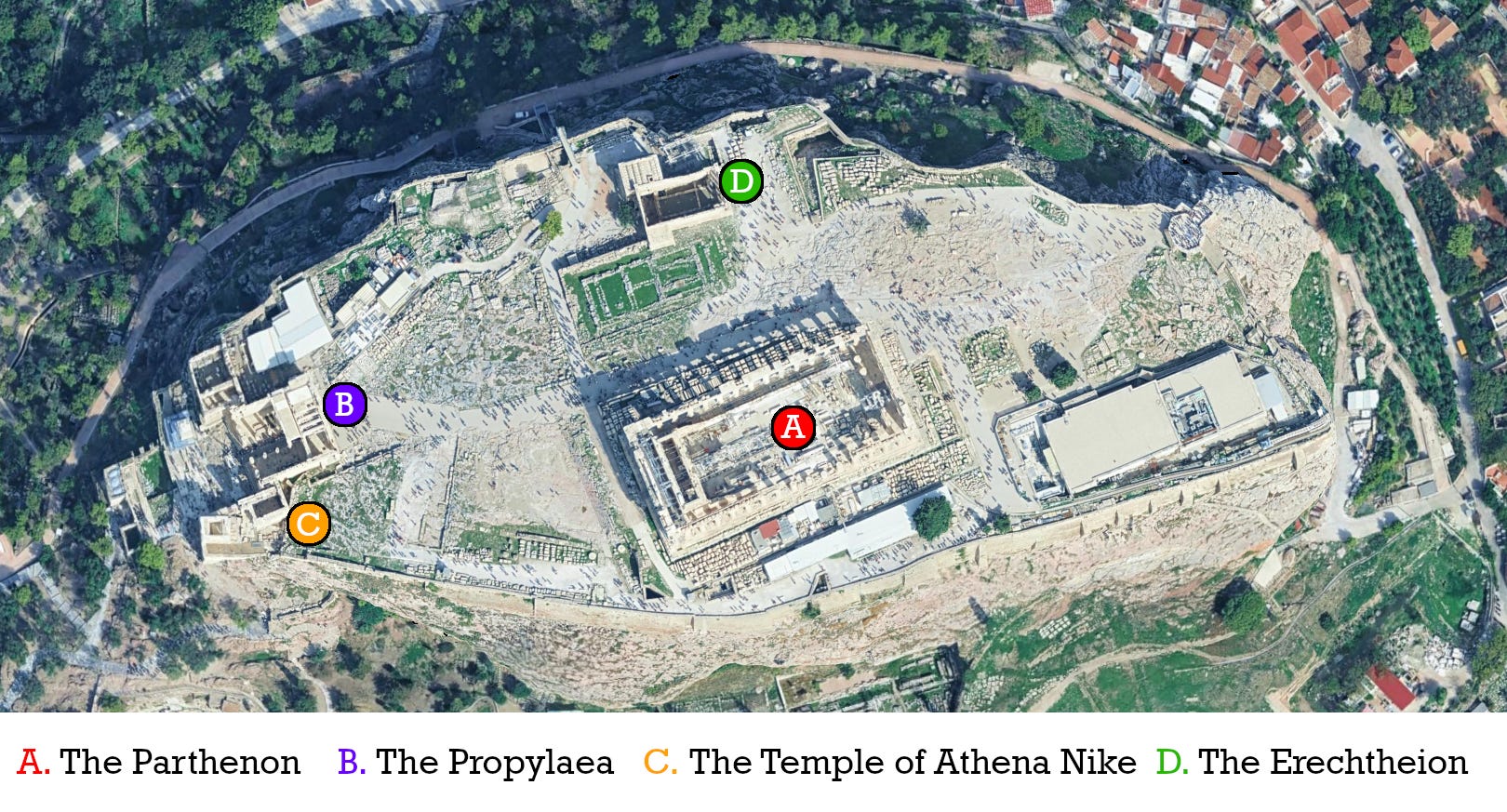
The Parthenon
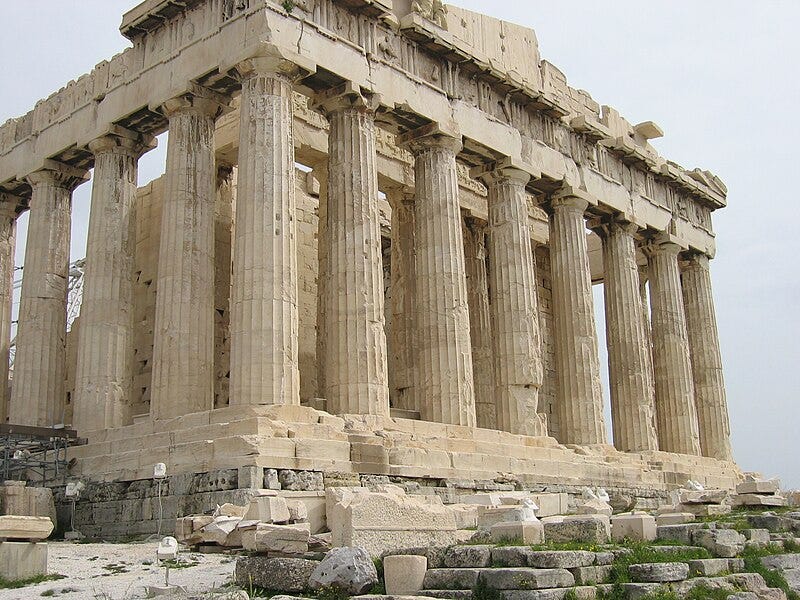
The Parthenon was constructed between 447-432 BCE. It was originally built as a temple dedicated to the Greek goddess Athena Parthenos, who was the patron deity of Athens. It's actually up for debate, though. Some scholars question whether it was originally intended for religious worship since no altar from the 5th century (when it was made) has been found.
The Propylaea
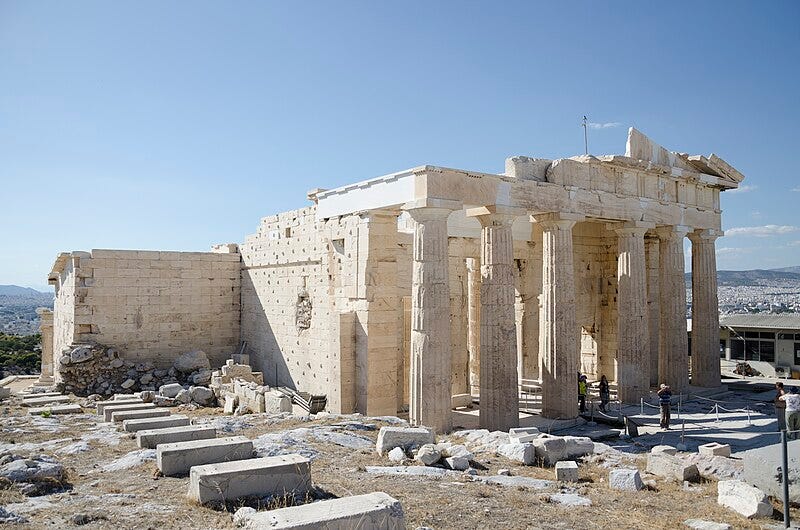
The Purpose of the Propylaea was to separate the secular and religious parts of the city. It was a ceremonial gateway that had five entrances. Four were used for foot traffic, and one central entrance was for wheeled traffic.
Temple of Athena Nikè
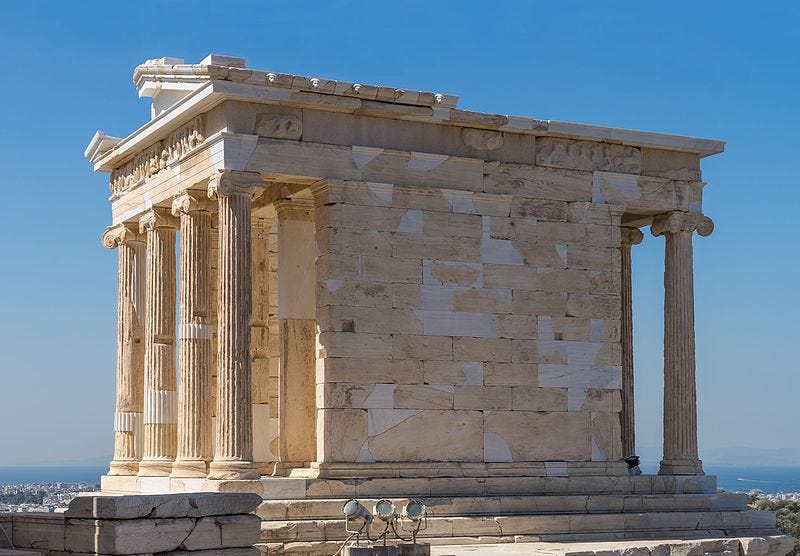
Flanking the Propylaea to the south was the Temple of Athena Nikè. The temple was dedicated to the Goddess Athena in her role as Nike, which means victory in Greek.
Temple of Erechtheion
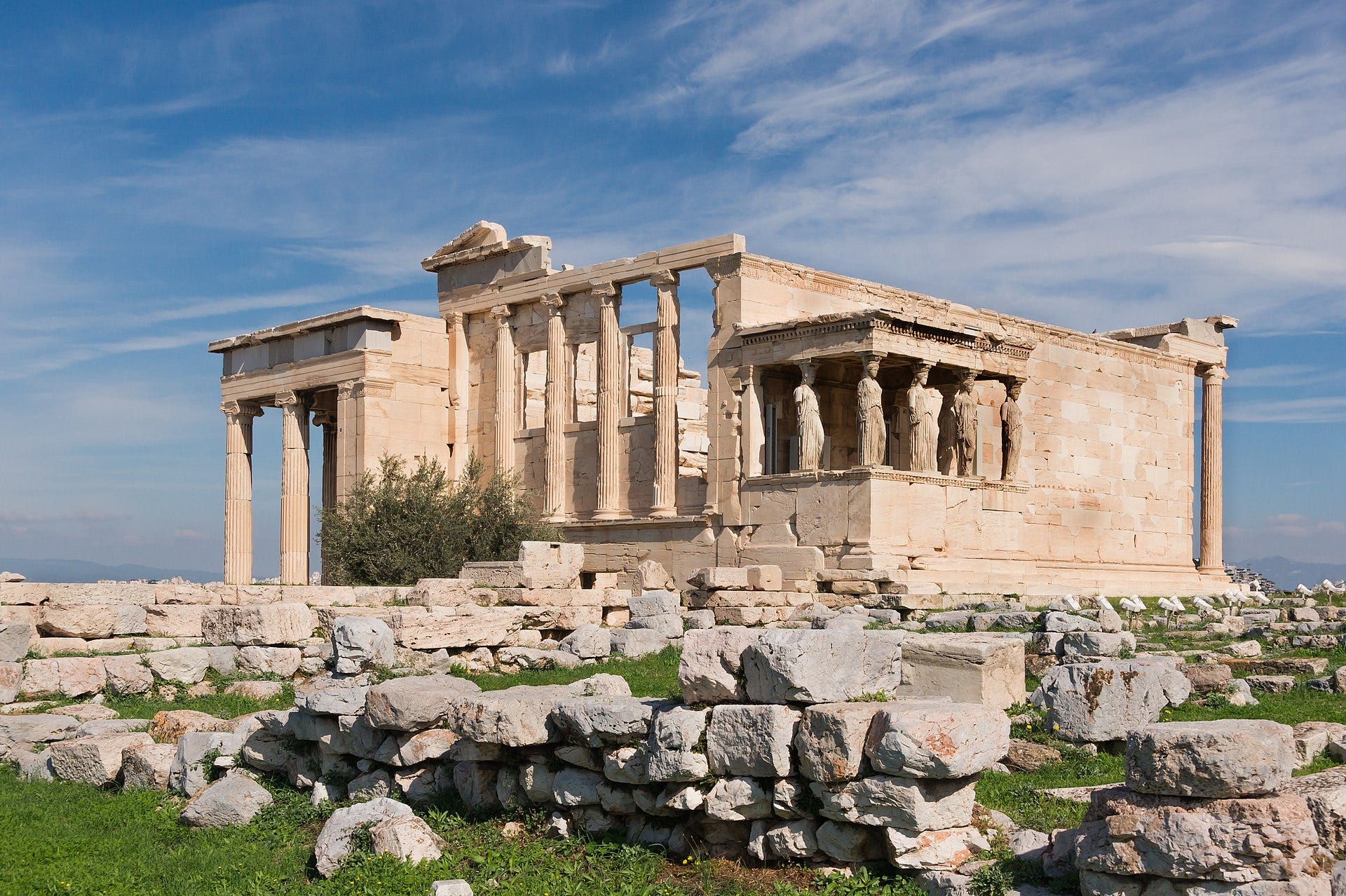
The Temple of Erechtheion contained several shrines and statues attributed to several Greek Gods, including Athena Polias, Poseidon-Erechtheus, Hephaistos, and others. It was named Erechteion, likely because it was built on a site associated with the mythical contest between Athena and Poseidon. Poseidon-Erechtheus merged the identities of Poseidon, the god of the sea, and Erechtheus, a mythical king of Athens.
This is a bonus article for Meridians:
EP4: “From The Oracle of Delphi to the Rise of Pharmacology.”
To listen to the episode, search for "Meridians" wherever you get your podcasts.
Sweet as hell post! Love it.
Very nice. I always wonder what the Greeks were up to between Leonidas and Alexander. This snapshot was excellent.